Bill of Lading in Maritime Transportation

While billions of dollars’ worth of cargo move from one port to another every day in global trade, the Bill of Lading plays a key role at the center of this process. The ability to transfer ownership of cargo, provide payment security, and protect the rights of the carrier, shipper, and consignee makes the Bill of Lading much more than an ordinary document. It provides documentary assurance for the transportation and delivery of cargo. This is why the question “What is a Bill of Lading?” frequently arises, as it serves both as a transportation document and as the document that determines who is entitled to receive the cargo.
In this guide, we explain the different types of Bills of Lading, how they are prepared, and their practical functions in a simple and straightforward manner. Reviewing a Bill of Lading sample can also make it much easier to understand the structure of the document.
What Is a Bill of Lading (B/L)?
Simply put, a Bill of Lading (B/L) is an official document issued by the carrier or its authorized agent confirming that the cargo has been received for transportation. At the same time, it guarantees that the cargo will only be delivered to the rightful party at the destination. It is a document that records the transportation process, controls the delivery of cargo, and represents ownership rights. In maritime transportation, it is considered one of the essential documents for both logistics and international trade operations.
Key Features of a Bill of Lading
A Bill of Lading is not just an ordinary document. In international trade, it performs several important functions simultaneously. On one hand, it serves as a receipt by confirming that the carrier has received the cargo. On the other hand, it records the terms agreed upon between the shipper and the carrier, making it evidence of the contract of carriage.
Its most significant feature is that it represents title to the cargo. In negotiable Bills of Lading, ownership rights may be transferred through endorsement. This means ownership can change hands even before the cargo physically moves from its location. This feature directly contributes to both the speed and security of international trade operations.
The cargo details, quantity, packaging condition, and transportation information stated on the document are considered official records. Therefore, even a minor error or omission can lead to serious issues later in the process.
Types of Bills of Lading
Every shipping operation is different. For this reason, Bills of Lading vary according to specific criteria. Different types of Bills of Lading are used depending on their purpose, transportation model, and delivery process.
Bills of Lading by Form of Issuance
A Straight Bill of Lading allows delivery only to the consignee named in the document, making the delivery process more controlled. An Order Bill of Lading is one of the most commonly used types in international trade. It can be transferred through endorsement, allowing ownership rights over the cargo to be assigned to another party.
In a Bearer Bill of Lading, whoever possesses the document is considered the owner of the cargo. While this provides speed and flexibility, it may also create security risks.
Bills of Lading by Operational Structure
Different shipping operations may require different types of Bills of Lading. The Master Bill of Lading (MBL) is the primary transportation document issued directly by the carrier. The House Bill of Lading (HBL) is issued by a freight forwarder and is commonly used for consolidated cargo shipments.
A Charter Party Bill of Lading may be issued when transportation is carried out under a vessel charter agreement. This type is frequently used in bulk cargo transportation.
Bills of Lading by Transportation Mode
A Direct Bill of Lading indicates that the cargo will be transported directly without transshipment. For multimodal operations involving combinations of road, sea, and rail transportation, a Combined Transport Bill of Lading is used.
In transshipment operations, a Through Bill of Lading covers the entire transportation route under a single document, providing significant operational convenience.
How Is a Bill of Lading Prepared?
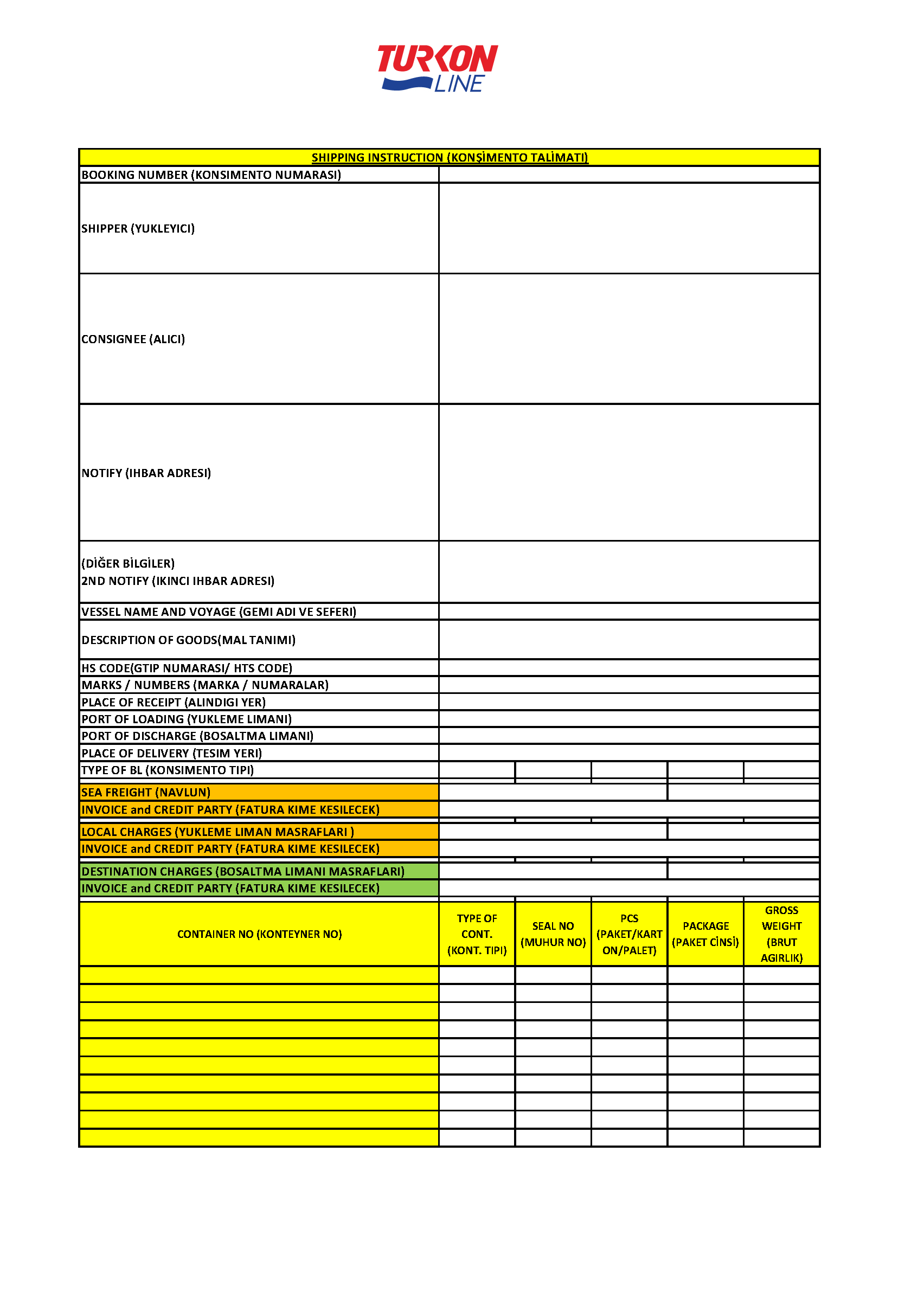
The process begins when the shipper provides shipping instructions to the carrier. Cargo information, consignee details, container numbers, and transportation information are submitted to the carrier or agent. Based on this information, a draft Bill of Lading is prepared.
The information on the draft Bill of Lading should be carefully reviewed. Particularly in Letter of Credit transactions, even a minor error may result in payment delays or customs-related issues.
Once the cargo has been loaded onto the vessel, the Bill of Lading becomes official and the “Shipped on Board” notation is added to the document. The original copies are then distributed to the relevant parties.
Sample Bill of Lading Instructions;
Information Required on a Bill of Lading
For a Bill of Lading to be considered valid, it should include carrier, shipper, and consignee information; the port of loading and port of discharge; cargo description, quantity, and freight details. Information such as the date of issue and Bill of Lading number is also essential for official procedures.
Since incomplete or inaccurate documentation may cause disruptions in cargo delivery processes, all Bill of Lading information should be prepared with great care.
Who Issues a Bill of Lading?
A Bill of Lading is generally issued by the carrier, the shipping line’s agent, or a freight forwarder. Under certain circumstances, the vessel master may also have the authority to issue the document.
Today, most Bills of Lading are prepared through shipping agents, helping operations move more efficiently.
When Is a Bill of Lading Issued?
A Bill of Lading is issued after the carrier has received the cargo. However, one of the most important milestones in international trade is the moment when the cargo is physically loaded onto the vessel. Once loading is completed, the “Shipped on Board” notation is added to the document and the official process begins.
This date is critical in terms of delivery, payment procedures, and risk management in international trade.
Why Is a Bill of Lading Sample Important?
Reviewing a Bill of Lading sample can be especially useful for companies that are new to international trade operations. It helps them better understand what information is included in the document and how it is structured.
A properly prepared Bill of Lading helps speed up customs procedures and reduces the risk of transportation-related issues. For this reason, companies should manage their Bill of Lading preparation process with great care.
Latest Turkon releases